

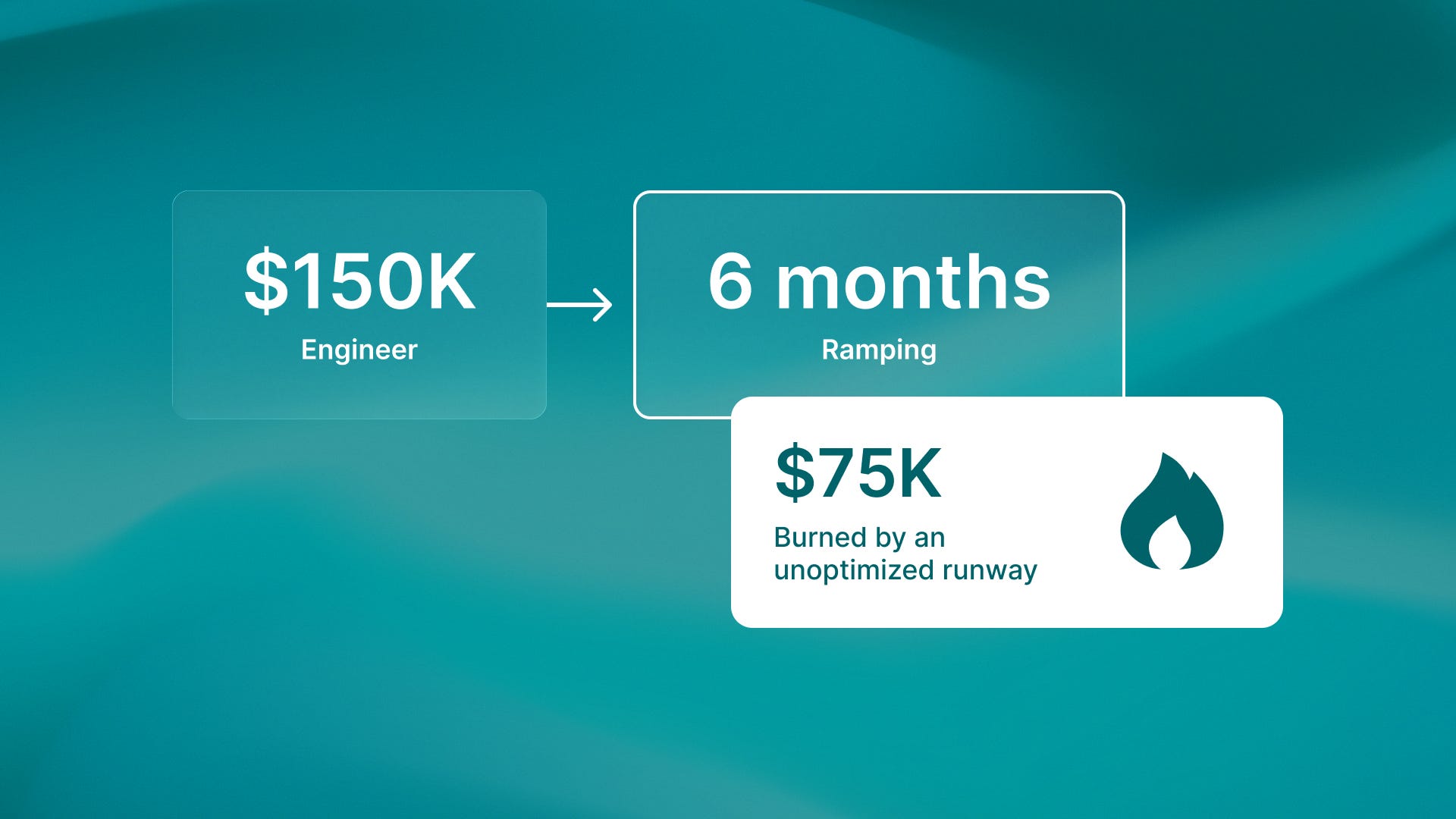
If it takes six months for your $150,000 engineer to start shipping meaningful code, you didn’t just lose time. You burned $75,000 in unoptimized runway. Most founders I talk to accept slow ramping as a cost of doing business. The reality is that it represents a technical failure. In a remote-first world, onboarding debt slows progress. It adds hidden costs before a developer fixes their first bug.
I’ve been watching companies like Islands struggle with this. They bring on high-caliber talent but provide no map to the codebase. The result is a ramp gap: a hidden burn rate multiplier that makes every hire progressively more expensive. If you are managing a Canadian team, you need a 90-day engineering onboarding plan. This framework shifts engineers from learners to contributors in week one. It prevents the $120,000 to $200,000 losses associated with technical hire failures that stem from unstructured evaluation.
The hidden cost of onboarding debt
Traditional onboarding takes six months to reach full productivity. That delay is devastating for a Series A startup. By codifying a structured 90-day engineering onboarding plan, you save tens of thousands in unoptimized payroll. I have seen too many companies treat onboarding as an HR task. It is a systems engineering problem. If your codebase is too complex for a new hire to make a PR in their first four days, the problem is your documentation.
High-impact documentation reduces coordination overhead. It also prevents the hidden costs of freelancers from bleeding into your full-time team. These overhead costs are often underestimated by 30 to 50% (Timecapsule). When you lack a clear ramp process, your highest-paid senior engineers spend more time answering basic questions than building new features.
Why early codebase contribution is a forcing function
Pushing code within the first week is a pattern I see in high-performing teams like Shoreline. It shifts the psychology of the new hire. They transition from being a visitor to becoming an owner. This is critical for Canadian tech talent onboarding where synchronous knowledge sharing across time zones requires immediate immersion.
Role benchmarking foundations
Founders should use standardized role benchmarking to ensure expectations align with reality. According to GrowTal, a lack of realistic KPIs in the first 90 days is a primary driver of churn.
Managing technical bottlenecks
When an engineer knows exactly what success looks like at day 30, 60, and 90, they spend less time guessing and more time shipping. This clarity prevents the structural QA bottlenecks that emerge when developers don’t understand testing requirements.
The 90-day framework for Canadian remote teams
Scaling in Canada offers a technical and financial advantage. Beyond the 40% salary savings compared to U.S. hubs, you can access SR&ED-eligible workflows. This adds a cashback layer to your engineering spend. However, this only works if your onboarding and development processes are documented for audit.
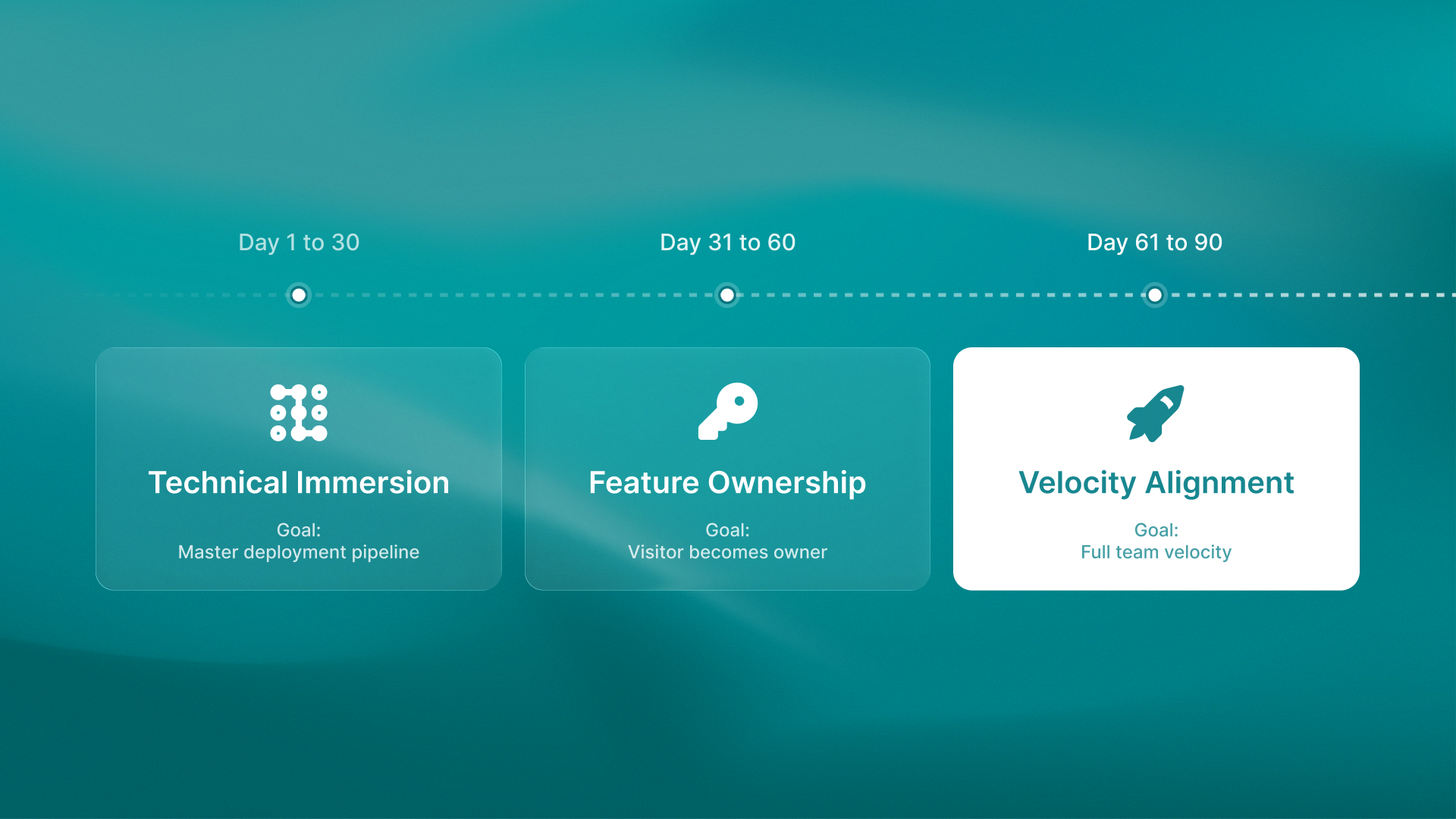
I recommend a three-phase approach:
Days 1-30: Technical Immersion. Focus on small bug fixes and Good First Issue tickets. The goal is to master the deployment pipeline. Using commit-triggered test generation can help new hires validate their work without waiting for manual reviews.
Days 31-60: Feature Ownership. The engineer takes responsibility for a standalone component or sub-feature. This reduces remote engineering ramp time by creating clear accountabilities early.
Days 61-90: Velocity Alignment. The hire begins participating in architecture reviews and mentor cycles. They should be meeting software engineer productivity metrics established during the benchmarking phase.
I have found that teams often mistake individual coding speed for team velocity. As reported by Islands, AI tools can boost task speed while creating new technical debt if workflows aren’t redesigned. A fractional leader can often build the machine that processes new talent without these side effects. Just as ReachSocial automates repetitive tasks to ensure consistency, a strong onboarding system speeds technical proficiency.
Maximizing your cash recovery with Shoreline
When you hire via Shoreline, you are getting a partner who understands how to optimize for Canadian tax benefits. These credits can save you 50 to 65% on tech payroll. But these credits require proof of technical experimentation. If your onboarding doesn’t emphasize systematic codebase contribution, you leave money on the table.
Speed is the only real advantage a startup has. If you waste six months on a ramp up, you hand that advantage to your competitors. Companies that skip these steps often face the same delays as traditional manufacturing. A lack of infrastructure can keep products off the market for years.
What to do next
Measure your Time to First PR for the last three engineering hires: if it is longer than 5 days, you have an onboarding bottleneck.
Audit your technical documentation to see if a senior dev from outside your company could understand the architecture in 24 hours.
Standardize your 30/60/90-day benchmarks for every engineering level to remove ambiguity from the ramp period.
Call Shoreline to discuss how to structure your Canadian hires to maximize SR&ED tax credit eligibility.
Ready to scale without the onboarding debt? Build your high-performance Canadian team with Shoreline.